Juggling and Balancing Multiple Needs or Multiple Kids as a Kinship Caregiver
Becky Schmidgall, Kinship Family Group Facilitator
As kinship caregivers, juggling multiple needs and/or multiple kids is a daily task. It may even become your “default” setting - constant multitasking, scheduling, and coordination. The mental gymnastics that it takes to do all this takes a toll on our mental and physical well-being if we aren’t proactive in taking care of ourselves. This February we are turning our attention towards self-care as self-love, specifically how we do this when our reality looks like the juggling act of a circus.
Think about a day when you were able to accomplish multiple tasks or bring your kids to multiple places around town. Now think about a day when all you could do was keep your kids clothed and fed. (We have all been there, by the way - you are not alone!) The difference between these two examples is your capacity, also known as your “window of tolerance.” Psychiatrist and neurobiologist Dr. Dan Siegel coined this term to refer to a person’s optimal range of emotional arousal within which a person can function, think clearly, and manage life’s stressors without becoming overwhelmed or shutting down.
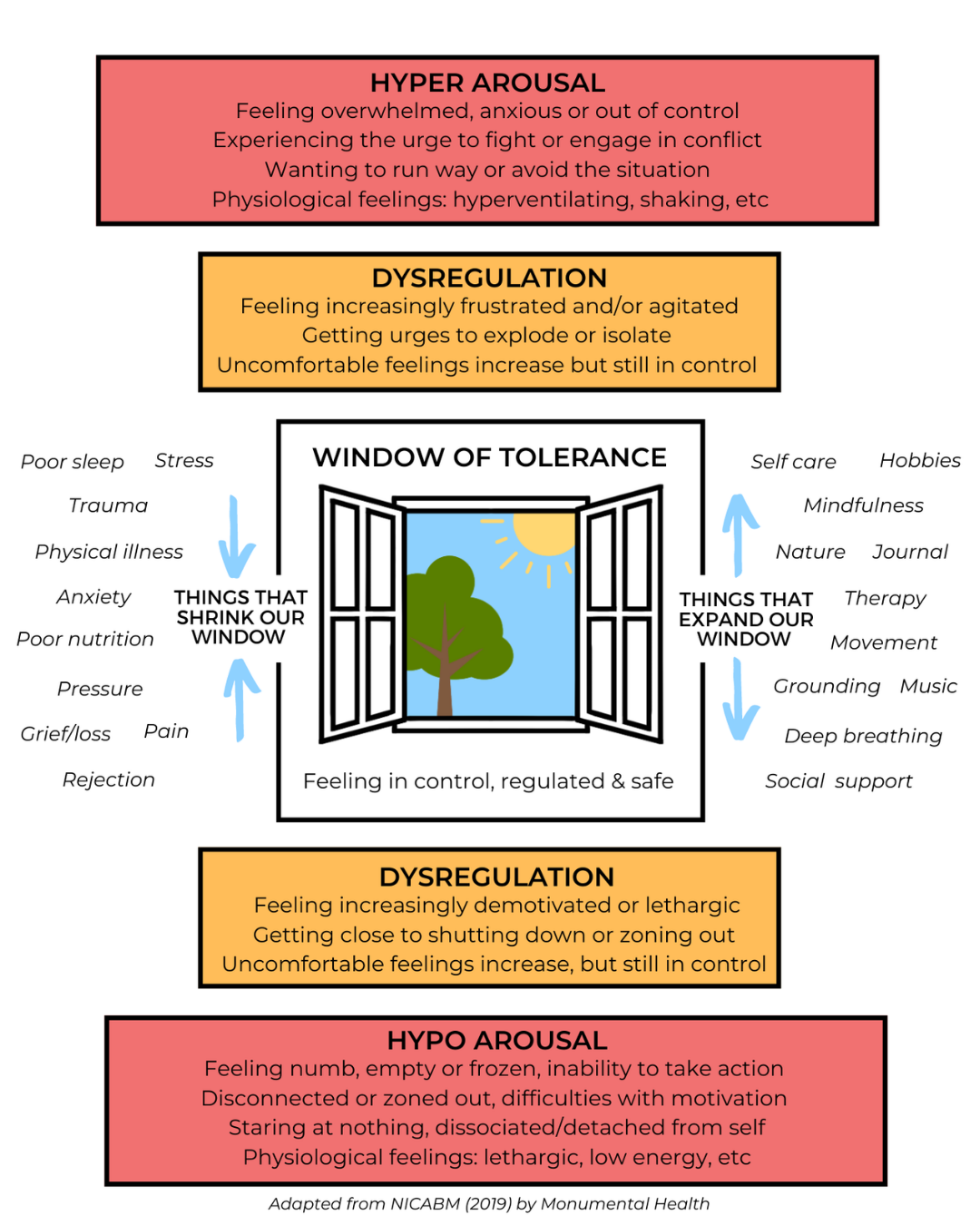
When a person is functioning within their window of tolerance, they are able to maintain a level head, make thoughtful decisions, and balance both positive and negative interactions without losing their cool. However, when a person is functioning outside their window of tolerance, they enter either a hyperarousal or hypoarousal state - either becoming emotionally volatile and reactive or becoming withdrawn, isolated, and depressed. Minor inconveniences such as multiple red traffic lights or a missed phone call could result in a hyperaroused person yelling in their car or snapping at a loved one.
There are numerous factors that impact a person’s window of tolerance- genetic disposition (some folks are born with wider windows than others), environment (where you are on a given day may make your window wider or narrower), trauma history, current stressors, chronic health conditions, nutrition and sleep habits, engagement in therapy, exercise, self-care, social support, and so on. This means that, in many ways, you can take the initiative to widen your window of tolerance and have more capacity to function at your optimal level. When we are bogged down by the responsibilities of caring for children, it can feel like nothing is within our control. Let me encourage you, friend, this is not the case! There actually are steps you can take to have greater clarity of mind and manage the chaos of life while keeping your head on straight. It is as simple as this: take care of yourself.
Things that shrink our window: anxiety, stress, poor sleep, trauma, physical illness, poor nutrition, pressure, grief/loss, pain, rejection
Things that expand our window: self-care, hobbies, mindfulness, nature, journal, therapy, movement, grounding, music, deep breathing, quality social support
In our kinship group this month, we learned about the window of tolerance and discussed a variety of strategies we could use to widen our personal windows. Caregivers shared skills they use already and ones they are curious about trying. We were able to practice a breathing exercise together and provide families with free online resources where they can explore more, such as these beginner-friendly chair yoga classes: a brief 5 minute exercise and also a 17 minute option.
It was so uplifting to hear what caregivers are already doing to take care of themselves, and to hear them speak words of encouragement over their peers during our group discussion. This month’s kinship dinner was a timely reminder of how valuable this community is, and how the love shown towards yourself multiplies outwards towards those around you. The caregivers we serve at SCC are a true gift to each other, and it is a true honor to bear witness to that, as we meet each month.
Here are some additional helpful short videos if you’d like to learn more about the window of tolerance and how to widen your window:
Widening your window : doing small, growth-oriented things that make you uncomfortable over and over again; emotional safety and emotional muscle
Strategies to widen the window orient yourself, open body posture, hand on your heart, social engagement, brain-body connection, trauma therapy
Strategies to widen the window when in hyperarousal body scan, body movements, sensory grounding, bilateral stimulation
Strategies to widen the window when in hypoarousal sensory grounding, dance or walk, upbeat music, time in nature, observe your body