Developing Healthy Relationships as a Kinship Caregiver
Becky Schmidgall, Kinship Family Group Facilitator
Our society is in the midst of a loneliness epidemic. In 2023, the U.S. Surgeon General published an advisory on the healing effects of social connection and community. This advisory outlines the health impacts of loneliness and describes ways that we can, as a country, combat loneliness. There are both systemic and individual changes that must be made if we are to see Americans begin to rebuild connectivity, but luckily, we were created for community! As humans, we are made to co-exist with other humans. While we can survive alone, we cannot thrive alone.

That being said, kinship caregivers face unique challenges when it comes to building and maintaining community and friendships. Many families who attend our monthly dinners share that “other [non-kinship foster] parents don’t understand what I’m going through.” They may share commonalities with other parents, but the complications of kinship care can be difficult to relate to.
In addition, many of our families have children with a variety of medical or mental health needs, and caregivers are at maximum capacity, getting each child to every appointment - there simply isn’t time for meeting new friends or attending social events where new connections take place. One parent reported, “I’m in survival mode right now.” What would it even look like to make an attempt at developing healthy relationships during a season that seems so chaotic?
Picking the right people
It may seem like an obvious place to start, but you could start by identifying specific people who you’d like to know better. Are there people who already exist in your life that you could invest in a friendship with? A caregiver you met at a Seeds kinship dinner? A friend you fell out of touch with years ago when life got busy? Sometimes we assume that because an individual is a casual acquaintance, that is the role they must play, permanently, in our life. But that’s not the case! We can absolutely deepen our casual connections if we feel there’s potential for deep friendship. We can also tap into an existing friendship to get to know their friends more. No one has a monopoly on a friendship- you can gain new friends through existing friendships! It could also be helpful to identify qualities you seek in a friend by identifying what your personal values are.
One sticking point that women specifically run into is the belief that they should have a “best friend.” While this is a lovely sentiment, and may be something that we experienced during childhood and young adulthood, the dynamics of friendship are much different in adult friendships. Gone are the days when two friends have hours of uninterrupted time together on a daily basis, with few responsibilities and commitments.
It’s time for us to redefine our expectations of friendships, and to feel secure in the types of friendships we are able to maintain at this point in our lives.
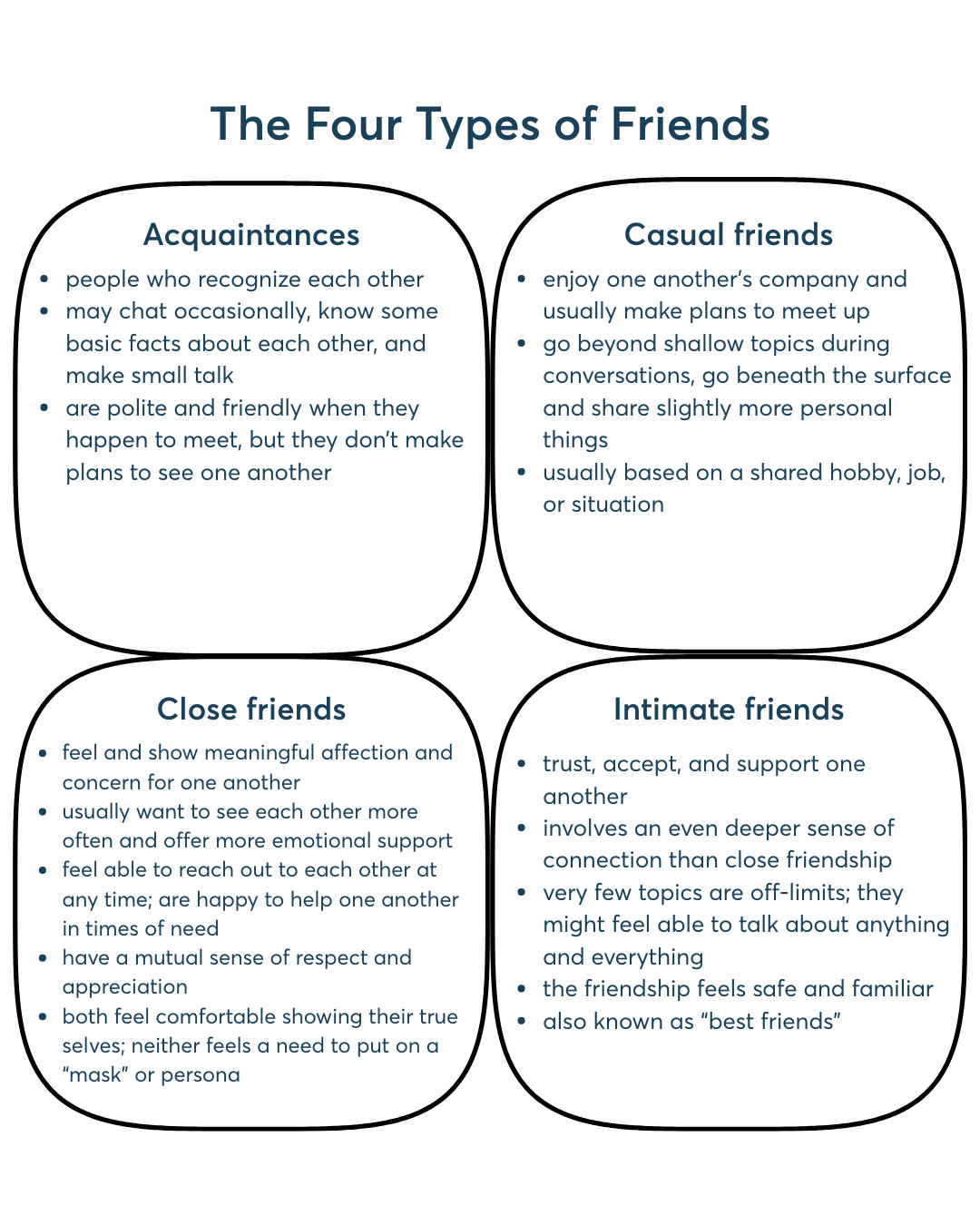
An important message for kinship caregivers - just because someone is family doesn’t mean they automatically earn the title of “close” or “intimate” friend. It is healthy to be aware of how the relationships we have with our family members affect us. Just like with non-family members, how do you feel after spending time with that person? Do you feel energized, neutral, or drained? If you feel drained, is this typical after any social interaction, or is this specifically after time with this person specifically? Paying attention to our body’s physical response can be helpful in determining if a friendship is a good fit, or if certain boundaries should be implemented with a friend or family member.
Initiating friendship
This may be the hardest part - but hard is not the same thing as bad. Be brave and take a risk; do something out of your comfort zone (even if that just means making the first move with a potential friend). It’s likely that the person you are seeking out is also eager for friendship! Don’t assume someone else will initiate plans or make the phone call. You can be the one to initiate; you can do hard things!
Making an effort to make plans shows the other person that you want to pursue or continue the relationship. One acronym some folks follow is “TCS” - text weekly, call monthly, see quarterly. That being said, life doesn’t always have to be super planned. If you have a free hour, why not meet up at the playground with your kids together? Or if you have no evening plans, why not invite your friend over for dinner? They can bring part of the meal! Bringing coffee to a friend at work, sending random texts about something funny in your day, and spontaneous hangouts are all ways you can show grow your friendship.
When initiating a friendship or attempting to deepen a friendship, patience is key. Research has shown that it can take more than 200 hours of time together to develop a close friendship. The process takes time. You may not see the depth of a friendship right away, but time will reveal the quality of the friendship if you both continue to prioritize the relationship.
Maintaining healthy relationships
We’ve identified a potential friend and initiated the friendship - how do we make sure this relationship continues to be an asset to our life? One expert suggests this boils down to three things: positivity, consistency, and vulnerability. And in order for us to maintain these three aspects while maintaining our mental and physical health, we need to establish healthy boundaries. Despite what some may believe, establishing boundaries does not simply mean “put up walls to keep people out or at a distance.” Establishing boundaries helps us to respect ourselves and set clear expectations for the people in our lives, and this can differ from person to person and from one relationship to another.
Healthy boundaries can also help us when determining how much and when to share about your story and your child’s story. Allowing others to get to know us better leads to trust, which is integral to establishing and fostering friendships.
But as a kinship caregiver, we must balance the responsibility of maintaining confidentiality for the children in our care, and discerning who can and cannot be trusted with certain information.
It is important that we use wisdom and discernment when deciding who we can trust with what information. Perhaps you have certain friends who can be trusted with most aspects of your life, but only one or two friends who you divulge details about your kinship relationships. It can be tricky to balance boundaries with vulnerability, but having meaningful relationships is worth the effort.

While vulnerability can be challenging, so can consistency when it comes to adult friendships. Remember: friendships as adults will look different from the friendships of our youth. We may not see our friends every day, but we can still find ways to be consistent and intentional. Both scheduled meet-ups (virtual or in-person) and quick texts, voice memos, or Marco Polos reinforce the value that the relationship holds. Make an effort to “do life together” - celebrating milestones and life events together, as well as touching base about the minutiae of your day to day. Regular, quick check-ins can go a long way in staying connected with your friends. Maintaining connection doesn’t require perfection - it requires showing up in small, consistent ways. The time investments we make in our friendships will pay back in significant ways.
It’s important to remember that consistency doesn’t mean 100% availability (this goes back to boundaries!). There will be times when a friend reaches out and we aren’t available. But make sure that if you aren’t available in the moment, offer an alternative time to meet up or follow-up with your friend. Offer support to your friends during good times and hard times, and this example will encourage them to do the same.
Know when to let go
The often-quoted poem “A Reason, A Season, A Lifetime” by Brian A. Chalker describes beautifully how friendships don’t always have to last forever. It doesn’t mean the friendship has failed, but simply that it has reached the end of its lifespan. Take time to grieve the loss if you need to, but also acknowledge gratitude for the gifts that friendship gave you over time.